
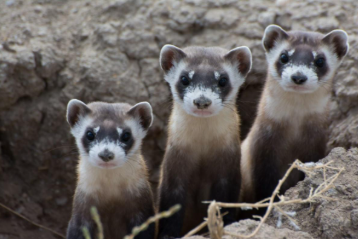
A Story Of Hope - And New Cause For Concern
by Molly Robertson, Program Director
One of the most remarkable conservation success stories in the United States is that of the
black-footed ferret.
In 1979, the black-footed ferret was declared extinct in North America, largely because of
the devastating decline of prairie dogs. An incredibly picky eater, the black-footed ferret depends
almost exclusively on prairie dogs for food—they make up about 90% of the Black Footed
Ferrets diet. Like a toddler who insists on eating only chicken nuggets, the ferret simply
would not adapt to another menu. So when large-scale poisoning programs decimated
the prairie dog population in the 1900's, black-footed ferret populations plummeted.
Then, on September 26, 1981, the species was given a second chance. A small population of
black-footed ferrets was discovered in Wyoming, launching one of the most ambitious wildlife
recovery efforts in our nation's history.
Thanks to the Endangered Species Act (ESA), which requires protection not only of endangered species but
also of the habitats they depend on, scientists, conservationists, and wildlife agencies worked tirelessly to save the
black-footed ferret. Through captive breeding, genetic research—including cloning—and the restoration of
healthy prairie dog colonies, the species has slowly begun to recover.
I love sharing this story with visitors, scouts, and students because it reminds us that when
people choose conservation, extinction is not always the end of the story. It is proof that
human action can change the future for wildlife.
That is why I was so saddened to learn that, beginning September 14, 2026, a new federal rule
will devastate one of the Endangered Species Act's most important protections. The Departments
of the Interior and Commerce have redefined "harm" to mean only direct physical injury to an animal.
As The New York Times reported on July 11, "under the new rule, destroying an
endangered species' nest or habitat would no longer be considered illegal. The change could
allow fossil fuel companies, agricultural interests, land developers, and others to destroy
habitat that many endangered species need to survive."
Once a species disappears, it is gone forever.
I think about the black-footed ferret, the burrowing owl, and the more than 1,300 animals
currently protected under the Endangered Species Act. These vulnerable animals do not have
a future if the habitat they depend on is not protected. Their future depends on protecting
the places they call home.
The story of the black-footed ferret shows us what is possible when we choose conservation. My
hope is that future generations will still have the opportunity to tell stories like this—not as
memories of what we lost, but as examples of what we chose to save.